Showing posts with label engineering. Show all posts

Monday, July 11, 2016

Udemy Course - Autodesk Inventor

I have done a lot of online video tutorials over the last few years. I recently decided to try out Udemy. This is the first course that I have created. It is a fast-paced introduction to Autodesk Inventor. Let me know what you think.

I do like Udemy they do a very good job of lining out instructors so that we create structured content.

Autodesk Inventor: The Basics

Here is my introduction video to the course and why CAD is so awesome


Tuesday, June 7, 2016

3-D Printed Microservo Robot Arm

This a project that I took on to create a simple robot arm for kids camps and classrooms. This arm is controlled by an arduino and uses 3 microservos. While it currently does not have a gripper that will be added soon. I will also be completing the kinematic model so that I can implement a positional controller into the arm.

When fully completed I will release the designs and likely produce a few as kits.

In the demo below I was controlling the arm through a keyboard.


Thursday, May 26, 2016

Portable Event Solar Phone Charger

This solar phone charger is designed to be deployed at outdoor events like weddings and concerts so that people can charge their phones. Normally extension cords or large cumbersome solar umbrellas have to be set up to fill this need.


The one issue is that people have to supervise their charging and the charger itself can be stolen. In a future iteration I will add essentially a port for a bike lock and locking compartments for phones to sit in while charging.

I would also like to spread the usb ports around the  edges more so that they are not so condensed. It will change the experience from waiting in line to just walking up and plugging into your own space.


Friday, March 4, 2016

Slant Robotics


I have formed a new branch of Slant Concepts...Slant Robotics. The "Jerry" Project is going to become an official product. Jerry is now being built in Nampa, Idaho with a projected reveal of a finished product at the end of April. Jerry is going to be the home robot that everyone has imagined.

Be sure to follow the project of Twitter or Facebook.


Thursday, May 7, 2015

My Tedx Talk

I was recently invited to give a Tedx Talk at my university. I ended up giving almost two talks in one. The first has part of the talk deals with how problem solving by humans is obsolete and inefficient. The second part deals with how if humans are not meant to be solely problem solvers what good are we and what is our secret sauce that will allow us to remain relevant?


Tuesday, March 3, 2015

Tour PNADDER

Tour PNADDER (Path Navigating Autonomous Differentially-Driven Escort Robot) is a project that I was a part of, as half of my senior project. The name is pronounced 'tor-nader.'

Tour PNADDER is meant to be a robotic tour guide for the Embry-Riddle campus. Guests will eventually be able to select a destination and the robot will lead them there.

Since, I came in at the half-way point of this project,  I did not have input on the initial designs, mechanical or otherwise (i.e. the name). My job, therefore, has been to design and develop the vision system that the robot is to rely on to navigate.

The vision system consists of a single Logitech webcam plugged into a Linux computer. I have to develop code, using Python and Open CV, that will let the robot know where it is with respect to the edge of any sidewalk on campus. I have never done anything with vision systems prior to this project.

The white lines display what the program believes 
to be the edge of the sidewalk.
The green line is a set-point to be used for localization
Performed on an indoor calibration grid I made.

So far, I have been able to implement a draft program that is able to run several filters on the video (Canny, Hough ...) to determine exactly how far the robot is from the edge of the sidewalk. This info will then be fed into a trajectory generator that will tell the robot where it needs to go.

I am still working to finalize the code. It runs a little slowly and has my error checking still in it. I'll post it when I'm finished.

Thursday, February 19, 2015

Rugged Prosthetic Arm Concept

I have wanted to build a heavy duty prosthetic for awhile. So I decided to get a basic concept design in CAD.

In the Slant Rugged Prosthetic 0.8, the elbow is supported by a bike spring. I downloaded the spring part, because of that the spring is a quite a bit larger than I would use in practice.

All the pieces of the arm are machined aluminum plates. This drastically reduces production costs of the prosthetic.

This arm is intended to be used by amputees with an active lifestyle. Its won't break and certainly won't short circuit. It could be used on snowmobiles, bikes, or water skis to give the amputee greater control and balance on the vehicle. It also allows for the user to perform heavier duty lifting, such as moving 2x4's, something no other prosthetic could withstand.

The passive design is a limitation since the arm is stuck in a particular static position, until the user basically leans into it. This is fine on an ATV, but not when moving boards around. (Check out my exoskeleton to see this problem in action)

Fortunately the design can easily be changed from using a spring to using a linear actuator. A slight adjustment in the fastening locations on the arm and a person would have a super strong arm, which would only require a very basic controller to operate.

But most of all this arm would be cheap. Maximum manufacturing cost would be around 200-400 dollars.

The next step will be to layout the manipulator and its attachment.

Sunday, February 15, 2015

Personal Submarine

This is a project that I found from a few years ago that I thought would be cool to share.

It is a design for a faceted personal submarine. It would have what are essentially trolling motors on the end of each fin. The two from fins can be angled by the pilot to turn and even submerge the sub because of the V-like design.

While not shown in this first Google Sketch-up Design the sides of the sub would have ballast tanks that would make it neutrally buoyant so the motors could take over.

The windows would be supported by steel bars so that the large panes don't have to support the water pressure entirely.


The faceted design was to make sure that the sub would be cheap to manufacture. You could just weld the panels over the internal frame. No molding.

This project could be changed to a pull behind sub, where it it is towed by a boat and the fins force it under the water. But then it would need to be a little sleeker. And the front fins need to be moved forward no matter what. So sue me I designed it in an hour.

Monday, January 19, 2015

Cardboard Robot

I was playing with the idea of a cheaper robotics platform. So I cranked out this head and hand using some old shipping boxes, servos, and an arduino.


Sunday, January 18, 2015

Wooden Gear Winch

This was a project in my Machine Design class. We had to make a super basic winch, which is boring as all get out. So I decided to make the gears out of wood, it was battle to convince the team, but totally worth it.

I used a band saw to carve them out of 5 ply construction board. They worked great and the winch made a great clacking noise when it ran.

We ended up being the only winch that worked perfectly on the first try. We also lifted the maximum weight available. We still don't know what the winch's limit is but it is well over 200 lbs.

It was ugly as all get out, but we were in a hurry. Function over form in this project. It only costs 35$ of pulleys and raw materials.

The large flap was  a widow-women brake


Monday, April 14, 2014

Power Claw

The Power Claw was an early prototype for an ultra-strong prosthetic/exoskeletal hand. It had over 100 lbs of gripping force using the simple linear actuator assembly. It was made from solid steel which made it far too heavy to be usable, but I was able to get a feel for the proportions and the effectiveness of the gripper arrangement.

This type of prosthetic, once fully developed, is for those who wish to have an extremely active and dirty lifestyle. Most prosthetics today are dexterous by very delicate. I wanted to work on the other end of the spectrum for those who will want to ride snowmobiles and work in construction.

The Power Claw would also be useful as a kind of "metal glove" for those that want to have a tougher hand for certain jobs.

I intend to re-work this hand in machined aluminum. I've also have found linear actuators that are faster, stronger, and more compact. This prototype will probably be added to the SPExs suit prototype.


Saturday, March 1, 2014

Tension Desk

This was a thing I came up with when I was working on making furniture that could be stored and moved more easily. This certainly does it. The prototype looks like junk because that was all that I had laying around. When I rebuild it it will be solid stock and will have a much better look similar to the CAD drawings. I use the prototype for a design desk, since I can easily change the angle of the surface.
    

Embry-Riddle Innovation Lab

This is one project that I am very proud of thus far. Embry-Riddle has had an apparent lack in space where students such as myself could work on personal innovation outside of classes. So, since 2012 I have worked with some friends to create a maker/design space on campus. We have the space up and running now we have to continue the grow the Maker influence on campus

Addendum: The lab is still operating and continues to be frequented by students. My involvement has ended as I will be graduating in 2015, but I still use it. The lab is fully accepted by the campus administration and there is talk of another being built. 
Here is the website for the Innovation Lab 

Quickbot from Model R

This was a project that I made to demonstrate how easy it is to create a working robot with the Model R platform that I designed for Universal Mechanisms LLC. So I grabbed some surplus drill motors (one of my favorite power-cores) and a model truck battery with a couple of switches and built this guy in under an hour. Gross and ugly, but it showed the concept.

Model R

This project is the development of the Model R modular hobby robotics platform. It was recently presented in an uncompleted form on Kickstarter.

This is the link to the Universal Mechanisms website                          er
Universal Mechanismsg                                 


RC System for New Holland TV 145 Tractor

I was contracted to build this system for a local rancher so that he could control his tractors from a wagon that they pull so he alone could complete a certain task, which used to require two people.

I completed a product form of this system several months ago that the rancher is using extensively. The very first test of the project can be seen below. 

It is much prettier now, believe me. It looks nothing like the first draft prototype in the video.      

Test of RC Tractor System


Un-powered Exoskeleton

This project is meant to be the implementation of an exoskeleton that uses no power to offset loads that workers and soldiers must bear in their respective environments  I have made several prototypes that have proven the concept. I am currently refining the design.


Thursday, February 27, 2014

3D Printed MultiTools

These multitools, which I designed with Google Sketchup, are something that I wanted to have around.
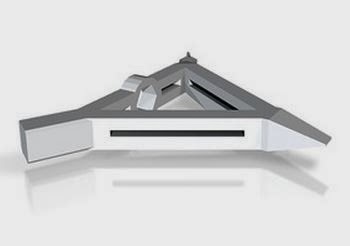
So I made them and had them printed. Since they were there, I decided to set-up a Shapeways store so anyone can get the designs printed.

The PentaTool at the right actually has, up to eight separate tools in it.


This bracelet multitool was meant to reduce
the clutter in my pockets if possible.


The TriTool at the right is actually my favorite. One because it is cheaper, two, it is just better. It has the same seven tools in it that are also part of the eight that the PentaTool has.

Saturday, February 8, 2014

Vertical Wind Turbine

This is a project I built in high school when I was interested in renewable energy. This wooden turbine prototype was designed to react to wind in any direction and have as little resistance as possible. Each turbine flap is hinged so that each will fold in against the center of the turbine when moving into the wind but extend when moving with the wind. The hope was to gain the maximum efficiency from a breeze.

When it was done it did work. But because the wood is a little too heavy for the application, when the turbine began to spin very quickly the flaps would begin to extend, due to the centrifugal force, and the efficiency would be lost. But that is an easy problem to fix with reduced generator speed and lighter flaps.

It was made with a lazy-susan and a few scrap pieces of plywood from the high school wood-shop.